I'm Jim Cave, I'm in Mali and these are my notes

I'm Jim Cave, I'm in Mali and these are my notes

Monday, May 7, 2012

Final Post

A little over a month ago life for the people of Mali got a whole lot more complicated, and I have been caught in the wake. For those of you who do not know, Mali is the midst of a civil war fought between the desert like North and the more temperate South. In mid-March, Mali also went though a forceful change in government and soon afterwards Peace Corps left. I am not going to comment on the civil war or the coup beyond this, good people have died, peaceful people have had their lives forever altered and no one knows what the results of all of this will be. A country that was once at peace is now partially filled with chaos. The oddest part is that I know my little village is still the same. I know that if I teleported back there I would not be able to tell there was a coup, or that a war is being fought. For my last blog post in the foreseeable future I am going to list a few of the things I am going to miss most about Mali and try and say what they mean to me.

IMG_0804

The Coulibaly Family- I am not sure what kind of relationship I expected to have with the family I stayed with during my time in Mali. However, it surely was not as intimate and amazing as what I ended up with. I went into the situation looking for something along with line of a work partner and someone to watch out for me. What I ended up with was two people that I think of as an older brother and sister that are great parents to a bunch of the best kids I have ever met. Esayi is someone who I will always look to as a role model. In many ways he is the man I want to be, but in a remarkably different situation. He is strong, kind, family orientated and someone that his community looks up to.

IMG_0863

Annie is just a fantastic and loving individual that took me in and made me feel like I had a friend from the first day that I arrived in village. She never tried to pander to me and was there to talk about whatever I wanted to talk about. All of this at the same time she participated in a number of community organizations, cooked for a large family, looked after four kids and somehow managed to take the time to be an ideal work partner for me. Without the two of them, I would have been a FAR less effective volunteer and because of them the last two years have been two of the happiest in my entire life. I will never forget them and will do everything in my power to stay as close as possible to the two of them. They are truly remarkable people that have given their hearts to not only myself, but two other volunteers before me, my big sister of sorts Jennifer Davis and the original volunteer. For all that they gave they received no pay and they got no rent money for the house that they lent out for over SIX YEARS.

IMG_0872

I think one very unfortunate development of American society is how our culture interacts with children. While I lived in the United States (up though college), my interaction with kids was limited to those within my extended family and those I mentored though a program with Montana State. This might be because of the general lack of friendliness between neighbors, or maybe a rift has been driven between kids and “young adults” because of fears regarding sexual predators. I don’t really know why, but I know that that divide did not exist in Mali and I had around twenty little guys and gals that were like little brothers and sisters. These kids taught me a lot of things and I have no doubt that I will be a better father because of my interaction with them (Annie an Esayi are also great people to look to in this regard as well). In particular, I will especially miss my host family’s kids.

Thomas (14) was my teacher, farming partner and friend. Whenever we were out in the fields he would make sure to point out to me plants or animals and tell me about them. I can’t even count how many times I gathered something delicious while out with Thomas bumming around. If it was not for him I probably would not have eaten termites, hedgehogs, various lizards or all those little birds! Thomas was also my star pupil and the driving force for me teaching English in Village.
IMG_0866

Miriam (12) is brilliant, calm and collected. She and I would actually talk about what she was studying in school, not a common subject in Mali. In addition to cleaning and cooking, she dedicated herself to her schoolwork (this is nearly unheard of in a place where most women are not expected to be literate) and helped me learn Bambara. Growing up, I never had a sister and though Miriam I got a glimpse into what that feels like. Her and her younger sister made me realize that one day I want a daughter.

IMG_0830

Ema (10) is my sidekick. I do not know why exactly, but we immediately took a shining to each other and for the last two years he has been my quiet companion. Whether walking though town, playing catch, gardening, herding cattle or drawing random pictures he was there giving his two cents, smiling and laughing. I really miss my little buddy.

IMG_0867

I have come to the realization that I really did not understand what toddlers were before I came to Mali. They are these little people that can live in two worlds at once. One where the rest of us exist that anyone can see and feel. This world is far more concrete and boring than the one that is only open to toddlers. A place were their imaginations can transform them into whatever shape and size they deem desirable and everything seems to happen naturally in a pleasurable and amusing way. My guide to this secondary little world was my little sister Christine (the Malians think this impossible to say so they call her Tini). When I first got to village she feared and loathed me. Whenever I came around she would cry and run away. Run might not be the best word, because at that time she was still mastering the skill. Eventually, I won her over and now we are tight! Now she is a running, jumping and climbing machine that dances around and screams “Adama is here! Adama is here!” whenever I return to village from San. She has fallen asleep in my arms countless times and I believe I am one of her favorite people around. The feeling is mutual and I love this little girl with everything I have.

For the last two years these people have been my family and no one could have done a better job at that. I have felt at home with them from the very first day when I sat around with Jennifer, surrounded by people who I that time I had yet to know the names of, struggling to describe to them my brother back home. Little did I know that I would become so much a part of the family that on my second to last day in Mali, when Esayi’s younger brother (my neighbor, host uncle and good friend Yacuba) tragically died leaving behind five kids and a wife, he would call Jennifer and me to console with and draw comfort from. Though it was surreally sad to have my last moment with someone how had meant so much to me in a hospital morning, I was just glad that I could be there to help a man I view as a mentor and brother when he needed it. The craziest thing is that I know that is the situation was flipped and my brother was the one that died, it would be Esayi that I would by my side to help me out. I am crushed that I have been forced to leave these people without saying the goodbye that I would liked to have, and even that would have been hard. I do not know when I am going to se them again but it is not soon enough.

San Kaw- Throughout my entire life I have been lucky enough to have just a top notch group of friends, and for whatever reason I seem to be able to make new friends quickly. Right off the bat in Peace Corps, I met four people that would form four solid friendships with people who are still four of my best friends to this day. Anderson, Fletch and Ryan have been my “crew” since the first few days of training and we have only gotten tighter since. I could not imagine my time in PC Mali without these three and I know that we’ll see each other in the future. Grahm was my first friend in Mali and I could not have made a better pick! I am super excited for him to work close to Montana this summer. During my time in Bamako, I was lucky enough to get close to some of the coolest NGO workers around, right now I was talking about the Project Muso crew; Rebecca, Martha, Amber and Ian. You guys were some of my closest friends in country and meant as much to me as any PCV. You all are hardcore and hope you continue to do crazy things that help people out. I became friends with some great people, but in it took a little bit longer to meet my Peace Corps family.

The Crew

Once we swore in as volunteers ten people from Team America (my training class) went to a place called San. If you look up San in most travel books they will tell you that it is a gloried truck stop (which is true), but it is one truck stop that the ten of us came to love. Not only did we come to love the town, but we came to love each other as a family. We had wise older brothers and sisters in Holly, Brad and Caitlin that showed us how to exist and thrive in the climate we found ourselves in. I was surround with people that I not only liked, but admired personally and professionally from all over the country and a variety of different backgrounds. Virginia, Alyssa, Sarah, Megan and Lindsey were my new sisters and we shared many a fine conversation and much merriment was had. Tom, Henry, Mario, J Clay and James were my brothers. Clad in matching checkerboard soccer jerseys, we wandered the litter covered street drinking Beaufort, eating some great baguettes and settling Catan. Together we, San Kaw, helped each other though some challengers and rejoiced together in some memorable celebrations. We ended up liking each other to a humorous degree (a joke within Peace Corps was the “San Kaw really likes San Kaw”). Fortunately, our family grew.

San kaw

In my sixth month at site, while I was still a greenhorn, new volunteers showed up and they were pretty awesome additions. Chrissy and Michelle became my two nearest volunteers. They were like a unit from day one and it was great to see. Hannah was a breath of fresh air and made her stamp on the house. In particular, I want to mention Chrissy specifically. She was my neighbor and she was awesome (we’re talking best neighbor ever material)! Her level of integration into her village was inspiring and we clicked almost immediately. If I ever needed to speak English, or eat some just great food, I knew Chrissy was just a short 8k away. The Kennedys (their training group) added their flair to our family, but it was a decidedly feminine one. That is where our Goodfella (another training class name)came in. Flash forward another few months and Lyle showed up. Lyle was pretty up the perfect person to have gotten in San. I hope to spend some time with him in South America at one point, Lyle=the bees knees, nuff said.

Rounding out our pre-evacuation family is The Mad Hatters, and I consider myself a quarter Mad Hatter. I was their trainer and saw these guys within their first few hours in Mali. When I found out that Anthony, Michael, Karen and Cythia were our merry band I could not have been happier. Even though I spent a lot of time with these guys, it was not nearly enough. Expect letters and packages when you head off to your new sites.

San Kaw is a group that I will remember for the rest of my life and our time together is something I will always cherish. I know that everyone in that group will go on to do awesome things and I am just excited to see what those things are. Here’s to many excellent meals, excellent friends and to the best freaking guards in the entire world.

The Brousse- Over the past few years I have become very interested in people’s relationship with their surroundings. I have spent my entire life in cities and I believe that I have a fairly standard relationship with the cities I have lived in. In my mind, a city is its own little world cut off from things around it in mental attachment. The concrete sidewalks, manicured lawns and painted houses let you know that this is man’s world and one tends to forget how much even a world in the digital age relies on nature. You buy flour from the super market, and thus in your mind flour comes from the supermarket. You might know (I hope you do) that a farmer had to grow the grain for that flour in a field that he or she cleared. That grain then had to be milled before it went though further processing and showed up at the grocery store around the corner, but YOU do not experience any of that. Even though the city itself seemed to provide everything for me, it did not seem like I was ever a meaningful part of that community. Yes, I worked, had friends and was happy in my former places of residence, but there is a certain feeling that I did not know existed until I left the States and found myself in a very small village, in a very poor country and very far from the nearest paved road.

IMG_0846

For the last two years I have lived in a place where I knew where every road led to and had biked them all. I knew where every family lived and everyone knew me (not every hard when I am the only white guy around). I could go out into the bush to collect fruit and I farmed my own food, the earth and the labor of my friends and me fed the village. For most of the year I spent under two hours a day (including sleep) indoors. When you live like rural Malians do, then you form a different kind of relationship with nature. On a daily basis you interact with nature though your labor, not just though recreation. As a result you gain a level of respect for the land that is different from the one I felt back home. It was almost like the area itself was my work partner. For the last two years, I have really felt that I really knew an area and a community. I do not know if I will ever form that same form of relationship with an other area as I did with my village, but I am going to give it a shot. That may take the same sort of concentrated effort I put into establishing relationships during my first few months in village, but I am committed to giving it a shot.

IMG_0851

In conclusion, I got way more from my time in Mali than I could have ever wished for. I came to Mali looking for a job and maybe some sort of adventure. What I ended up with was a new family, a new home and some of the best friends a guy can ask for. Additionally, I had almost two great years that changed me in a meaningful way. I will always be grateful for my time in Mali and I will miss it.

Monday, March 19, 2012

Mining for clarity


We live in a world shaded gray. Despite how much we might wish otherwise, issues that are “black and white” exist almost entirely in fiction. Once in a while a issue comes along which personally tears at you, something that seems to pull you in either intellectually or personally not allowing you to escape. Such a perfect storm has risen in Mali and I can't shake it, I'm talking about gold mining. If you're scratching your head I'll try to explain.
I come from a place where the clash of ideas between between extractive industry and environmental conservation drive the historical narrative. The city of Butte grew with the mining industry in Montana and was prosperous for a time. However, the current and very visible legacy of the Anaconda mining operation is the Berkley Pit super-fund site (an environmental disaster and drain of public resources). The mines in Libby left a town with serious problem involving cancer related to exposure to asbestos exposure. A quick look at the list of states parks in Montana will show a number of once prosperous ghost towns that flourished for a short time after someone struck it big on a solid vain of ore.
I am a student of history and have taken a serious interest in environmental history (I've read a long about extractive industries often disastrous effect on an ecosystem). The dangerous effects of large mining operations on local water sources has been well documented. In general, my feeling of the mining industry is that it entires into an area exploiting it's resources until they are depleted and then leaves. The public at large is left to clean up whatever mess is left by the mining operation and the environmental impacts can be long lasting. However, I know that mining put the bread on the table for many Montana families and the industry has many supporters. As someone who consumers the products are the result of the industry (it is tough not to use metal) it is also at least a little hypocritical of me criticize the industry that I am patronizing. All this being said, I do not have a enthusiastic opinion of the mining industry and believe that ventures into expansion of extractive industry in general should be accompanied by analysis into environmental and public health impacts. This kind of analysis is not the kind of thing that I would expect from a poor country desperate for more industry and well paying jobs, Mali for instance.
Over the past few months a number of my good friends here in village have left for a few months in order to make some money while there is no work to be done in village. One particularly popular destination is the mines. It might be worth noting here that mining (in particular gold) is a benchmark of the Malian economy, providing one of Mali's major exports. It is hard to to explain the feeling I get when a sixteen year tells me that they are going to leave village to work and the place that they are going is the gold mines. The majority of the time these people are living in poverty and nothing comes easy. Village life provides a harmonious peaceful existence. However, harmony can't buy medicine for the kids and peace can't buy millet when the granary runs dry. As a result there is a “rural exodus” from every rural village in Mali.
Once work is done in the fields, and there is no income potential left in the village, the youth leaves to return a few months later. The allure of big money made quickly is understandably appealing to a migrant work force. Where things get complicated for me if that when a Westerner, just as myself, thinks of a mine in Africa the image isn't pretty. One thinks of near gulag working conditions where people do backbreaking labor to chase the fleeting chance of a fortune found though a finding an elusive nugget. Even if such a nugget is found, we imagine that the laborer only receives a small percentage of the market value for the nugget while the mine owner pockets a hefty profit. My negative opinion of the mines does not improve when news reports just as this one detailing child labor abusing and dangerous conditions seem to pour out of Mali. My already negative opinion of mining only worsens the internal wince I made whenever I hear of someone going off to the mines, but what do I do?
The major problem that I face when thinking about possible courses of actions upon hearing a friend is excited to go off into what I imagine is a terrible time is one common to development workers. Is my negative opinion of a result of my coming from a position of privilege? I have never really struggled for anything material in my entire life. I've never wondered if I could afford dinner, or had to venture off to labor to ensure the family stay afloat. My being born into a middle class American family ensures a life protects me from most of that. Additionally, everyone working in Mali works their ass off. I'm not sure how much worse the mines are than hauling two hundred pounds bag of cereals around. In the end all you can do is express my skepticism and wish them luck.

Here's some pictures

Saturday, March 17, 2012

Open for donations

A quick update on the bridge project. If you are a regular reader of this blog, then you might recall that I made a post about building a bridge at my site in order to expand infrastructure and remove a serous safety hazard. I was expecting for the project to be open for donations in January and many of you responded with verbal pledges of assistance (for which myself and the people of my village are very grateful). However, factors outside of my power such as international economics and critical staff members going on vacation has delayed the paper within the bureaucracy of Peace Corps Mali. After two months of waiting, this week the paperwork made it's way to Washington and has made it's way to the Internet. The project is now open for donations and the link is (https://www.peacecorps.gov/index.cfm?shell=donate.contribute.projDetail&projdesc=688-378). I'd like to thank you all for you interest in my work and support.

Wednesday, February 1, 2012

Sorry for the wait

In Mali things tend to happen slowly. Donni donni, a mantra for life here, translates to something along the lines of “little by little”. This same slowness applys to projects clearing Peace Corps approval. The bridge paperwork is still being looked at by Peace Corps staff, but it should be ready to be funded shortly. I have received a lot of support already and I would like to thank everyone for their help. Expect another post soon with a link to where you can donate.

Wednesday, January 4, 2012

A Very Mali Christmas


For the second year in a row, I wasn't at home for Christmas. Last year I went to Manitali, a beautiful town on a large lake to swim, eat and be merry. However, it didn't feel like Christmas at all. I remember thinking that the two years I spend in Peace Corps will be in a vacuum. I would miss things back home, but I wouldn't really have equivalents here in Mali. Well, things have changed in the last year. This year felt like Christmas.
Some of my best friends in Mali ( Anderson, Fletch and Ryan) decided to come to my site to spend Christmas and afterwards we went to Dogon country to do some hiking. Christmas itself was relaxing. We went to mass on Christmas eve and day and then spent the rest of the day kicking back enjoying the holiday. My host family cooked some great food and we had a swell day. Dogon Country was also very nice. The area is a giant plateau that borders the Sahara desert. The area is filled with cliff villages and is strikingly beautiful. Enjoy some pictures.

Wednesday, December 21, 2011

Building Bridges

I come from a line of growers and builders. My Grandpa Kuntz has made an honest living farming in North Dakota for the entirety of his life, his father was a farmer and I bet his grandfather was a farmer. My grandfather on my dad's side was a contractor based out of Montana. I've heard stories about my dad working on bridges, or my mom's tales of the farm for as long as I remember. If someone would have told me that I would be following in the steps of my forefathers a few years ago I would have hidden a scoff. However, I currently find myself a sorghum farmer researching seed varieties and companion planting possibilities. Now, the time has come to emulate the Cave side of my family, but I need your help. To put it simply there is bridge that needs to be built and I'm the only person in a position to facilitate its completion.

This next paragraph will be a basic summary of the problem that needs correction, and what steps need to be taken in order to alleviate the issue. I will give further information on how the project came about, implementation and exactly what you can do to help in following paragraphs. My site consists of a collection of four villages lumped together and given the name Zana. These four villages are Sobala, Zanso, Dangaso and Dombala. Most of the resources of the villages are located centrally in either Zanso or Sobala. These resources include a grinding mill and cereal bank which were built by Peace Corps. Additionally, the school, womens cooperative headquarters (main shea processing area), major meeting places and the market are all located in either Zanso or Sobala. Resources like a school, grinding mill and a market increase incomes and impart skills. Unfortunately, the citizens of Dombala don't have access to these important resources for a good portion of the year. During the rainy season (starting in June). a stream appears between Dombala and Sobala rendering the road impassible to cars and wagons and dangerous to pedestrians, bicycles and motorcycles. Consequently, Dombala is isolated from the rest Zana; Dombala's ability to use valuable community resources located in Zanso and Sobala is cut off. The road also poses a health risk due to motorcycle accidents. Labor to repair the road somewhat usable is not available until there is a lull in farming, this lull often doesn't come occur until December.                                              

clip_image002

Map of the area highlighting the problem

This project will improve the most dangerous section of the Dombala road by evening out the road and reinforcing it with concrete and rebar. Villagers will also take erosion prevention measures upstream from the improved section of road by planting trees and placing larger rocks. The community will provide all of the labor and locally available materials. Partners will provide concrete and rebar for construction. The number of Dombala citizens using Zana's resources will be used to measure success.

To give a bit of background on the project, I'll recount how the project came to be at the state it is currently in. I remember walking around village during my first week at site and running into a man who was excited to meet me, this man was a farmer from Domabala named Bakari Sogoba. Bakari took me over to the road that connects his village, Dombala, to my home, Sobala. Both of these villages are part of my site and the road that connects them does not so much resemble a road, it's more of a gorge. The road was definitely a problem, but it did not fit in with my ideas about what I wanted to do at site. As the months turned into a year, people of all sorts told me that fixing the Dombala road was a priority of their's. All four of Zana's village chiefs, the imam, pastor, dozens of mothers and farmers showed enthusiasm toward the idea. Support for improving the road was widespread and deeply held. It came as no surprise that during Participatory Analysis for Community Action (a meeting designed help establish reasonable priorities for development) that improving the road came out as the number one priority for both men and women. After witnessing the road further erode during rainy season and seeing a young man seriously injure himself trying to cross the road on a motorcycle, I decided to do what the community wanted/needed and focus on the road.

Upon expressing more interest into looking into the issue of the Dombala road, one of the masons in village came to me with a design for the road that would solve the problems and be relatively low cost. Peace Corps had built these type of road improvements in the past in a village about fifteen kilometers away (see picture below). In further meetings, two of the village masons volunteered their services and the village chiefs arranged other labor for the road improvement. Additionally, the village chiefs made it clear that maintenance of the bridge and erosion control would be a priority for the group of villages that currently works on road repairs biannually. For the most part this project was conceived, designed and will be executed by the people of Zana; I have just been a facilitator.

clip_image004

My counterpart Esayi inspecting a “bridge” similar to what we are looking to build

In order to construct the bridge the community will follow the implementation plan presented in the next few paragraphs. Construction will start as soon as funds are available, but we would like to start by mid-March. To begin with, community members will gather the required locally available materials (rocks, gravel and sand). Given the amount of these resources needed collection will take a week. Once the locally gathered materials are gathered, the concrete and rebar will be bought in San. Transportation of all of the cement and rebar could take three days. Once all of the materials are gathered and arranged to the mason's liking, excavation will begin.

Currently the stretch of road that we are going to work on is uneven and features some impressive drops. Before any work is done with the cement and rebar the road will have to be evened out. The road will be worked into an elongated U with consideration given to water drainage. Along with the leveling, three holes for the piers need to be dug to the depth of a meter. All of this excavation is estimated to take nine days. Once excavation is complete concrete will begin to be poured and rebar will begin to be laid. The rebar will intersect with another piece of rebar at a perpendicular angle every 20cm. Once the concrete is poured and finished, construction work is complete. Construction is estimated to take ten days. During the concrete laying/drying process great care has to be taken to ensure that no one/thing ruins the concrete before it dries.

clip_image006

1.) State of the road currently 2.)Post excavation 3.)Post Construction

Maintenance and upkeep of the road will be passed onto those members of the village that are chiefly in charge of road maintenance currently. The masons already possess the skills needed to keep the road running well. The road that Peace Corps repaired in a neighboring village is functioning under a very similar arrangement and is currently in great shape. Monitoring and evaluation of the project will be ongoing and primarily done by myself. I will get the different associations to keep track of the number of people whom are new participants from Dombala. Additionally, I will track the number of buyers/sellers using the Zana market that arrive on the improved road. Now that you know the work that the people of Zana are going to do, you probably want to know what you can do to help.

The people of Zana need a good road in order access available resources and have already invested a lot of time and planning into the project. However, we need your help in order to purchase the cement and rebar used in the repair of the road. Construction of the road requires three tons of cement at 125000CFA per ton for a total of 375000CFA in cement. Additionally, 45 bars of rebar #8 need to be purchased at 2000 CFA a bar for a total of 90000CFA. All together, partners need to supply 465000CFA in order to buy all the needed supplies. Using the current exchange rate of 501.73CFAs per dollar, the sum comes to $926.80. However, rumor is that the CFA will be devalued at the beginning on 2012 (which could lead to higher cement prices) and I've been advised to wait till early January to submit the final application for bureaucratic approval. If you are feeling the Christmas spirit and want to help some of the world's poorest people out, I'd ask you to set aside a little bit of money to donate to the project once it is up for donations. One hundred percent of whatever you donate will go to the construction of the bridge. There is no administrative costs and I will give regular updates as to the progress of the project. Oftentimes when you donate money to a charity and do not know what happens with your money after you give. With this you'll have an amazing and competent person that you know (me!) managing a project that will do lasting and concrete good to an entire community whom are willing to work for it! Additionally, the donation is tax deducible. I bet you're just salivating at the prospect of donating, but you'll have to wait to early January :( Once the project is cleared to receive funding I will post a link on this blog to where you can donate.

In summarization, some people in Mali need your help to improve a road that is dangerous and impassible. Improving the road will improve access to markets, make it easier for kids to go to school, improve food security by improving access to a cereal bank and grinding mill and reduce risk of injury. Once the funding is in we can start work.

Saturday, November 26, 2011

I think that we are going to be friends!

The last month has been such a change from my normal life in Mali that I've been left breathless. To recap, I've left my village and am living in Bamako for about a month working as a trainer for the newest group of volunteers. My role is to pass along technical skills (gardening, extension techniques, pest management, etc...) along with serving as a role model/peer support. Consequently, I've been spending a lot of time on a computer (a major change from village life) gathering information to present. Afterwards, I go off to a home-stay village and present this information to a group of trainees. I'm really enjoying my new role and I've been told that I'm alright at it. It's good to be working with staff and having a say as to what a new generation of Peace Corps Mali learns is nice, but the most rewarding part so far is getting to know the trainees. Three weeks back forty Americans came to Mali and with some determination in another month forty new volunteers will venture forth into Mali.

The trainees are not the only people that I've met during my stay in Bamako. As the holiday season approaches peoples families are pouring into the country. Most notably for me was the father, mother and brother of my friend, partner and site-mate Tom. It is always interesting to see where a person “comes from”, and it was apparent that Tom's family shares the friendliness, humor and sense of adventure that I admire in Tom. It was truly a pleasure to get to know them. Meeting other peoples families has brought out a sense of homesickness in myself. For two years PCVs leave home in order to go to a far off place. In this place they see, experience and feel things that simply cannot be expressed in words. In order to gain an understanding of what we do/where we live one would actually have to come to Mali. Knowing that you are experiencing something that most of your family and friends can't relate to is mildly depressing, but on the other hand it binds PCVs together forging a bond between volunteers. As Thanksgiving and Christmas approach I'm probably going to miss Mom, Dad and Rob more and more, but I have another family here to fall back on. Dozens of volunteers that have been my support for months and a group of forty new friends to bond with.

Monday, October 3, 2011

Act Three

It seems that I am turning the page on a new act of my Peace Corps service. Many of the people that have meant a lot of me over the past year have left. The work that I've done is starting to yield results that are appreciated within the community and new doors are opening. While my focus remains on my village, I now have the opportunity to change things up in the structure of PC-Mali itself.

A few weeks ago, my friend Bakari wanted to show off his millet field to me. I had given him improve seed to try out and record his results. The new millet was the first to bear seed (something that grows increasingly important as desertification increases). Additionally, the millet looks more healthy previous varieties use in the similar conditions. These tangible visible benefits are rare in development work and when you get this kind of victory you have to savor it. Other projects are starting to develop, but I think it is too early to talk about them in depth.

I've been chosen to be a trainer for the new batch of volunteers coming to Mali in October for the Environment sector. This means that I will have some input in designing the training for Volunteers that will be stationed all over Mali. I'm excited and honored to have this position, but it is somewhat bittersweet. I'm going to be away from village for Tabaski and most of harvest. I'm sure that I'll miss village and will have to have faith in my friends to report on crop progress in my absence.

As a closing remark, I had the privilege of meeting Jennifer Davis' mother during my last trip to Bamako. Jennifer was in my village before myself and stayed on with PC-Mali for a third year in Bamako. She has showed me nothing but kindness and has been ultra helpful. If I am to be consider to be a successful volunteer, then Jennifer is a major reason for my success. Jennifers' mother was just as sweet, kind and thoughtful as her daughter.

Tuesday, September 6, 2011

A Farewell to Departed Friends

When one contemplates joining Peace Corps, there is often a accompanying vision of what a PC service is going to be like. Visions of cute kids playing soccer, a tight knit community and a new sense of worth are common features of said vision. However, one thing no one thinks about is what happens when friends leave (If fellow volunteers fall into you ideal vision at all). How at some point in your service your life is going to change drastically. You’ll know this change is coming and there will be other distractions once it does, but one day you’ll look at a poster board full of people that are no longer in Mali. Your home has changed.

When I came to San a little over a year ago there were three PCVs, that had already been at site for a year, here to welcome me and show me the ropes. Assistance was given constantly and a friendship was developed. Before I knew it I had two new sisters and a brother here in San, people so much a part of my Peace Corps service that it is impossible to imagine it without them. Now they are gone and new volunteers will have no idea who they are. This is bittersweet. Most people are ready to leave at the end of two years, but no one likes to see a friend leave. So long Risky Business, it was a good time.

Farming is still farming, but in one week most of the “heavy work” will be done. After this we just wait till harvest. Esayi is going to Bamako for the month of September and as a result I plan to do a whole lot of walking around and drinking tea.

Things are swell

P.S. In addition to the slew on volunteers leaving, one of my cats here hit the bucket. R.I.P. Caya you killed a lot of lizards.

Tuesday, August 16, 2011

Farming Season (A Summary)


I haven’t written in a while (a reoccurring theme in this blog), but I have a reason for this. It is hard to write about things you’ve done when it doesn’t seem as if you done a lot. In a village the size of mine, farming dominates everything else and doing any sort of development work is really tough to do once the rains come. I’ve distributed new varieties of seed to some of the farmers to try out in small test plots, but that is about it as far as Peace Corps related work goes.

That being said I’ve spent a lot of time in the fields. Either plowing, weeding or planting begins as soon as breakfast is finished and is an all day affair. If one were to walk though village during midday they would be lucky to see an old woman. I now live in a place that is a ghost town from 8:00am to 7:00pm. Added onto this Ramadan just started, which means fasting for a good portion of the village while the sun is out. Everyone grows millet, sorghum, fonio and peanuts; a few people grow cotton and rice. Most people are initially shocked when tell them that I farm. “Eh!! I be se ka senneke! Eh!” (You can farm!). There is a general perception that white people are incapable of doing manual labor. I’m not sure if this is as strong as the perception that all white people have money, but it is certainly less true.

Life is good, Mali is pretty and I always have a place around the food bowl.

No complaints.

Sunday, June 26, 2011

The Triumphant Return of Adama Coulibaly

Over a month has past since my last blog post and a lot has happened. A trip back to America to see two dear friends get married. The start of rainy season and the beginning of farming along with it. Lastly, I put together another formation this week.

When you join Peace Corps inevitably you do a lot of reading on the organization and the lives of other volunteers. During this literature review one will discover that many people (and the Peace Corps itself) warns volunteers of the dangers of going back to the States. A once well integrated and well functioning volunteer at site will come home to find comfort, excess or security. The volunteer asks themselves “Am I really doing any good over there?” Before you know it the volunteer decides that going back to their host country would be a mistake. I am probably over simplifying the issues, but once I came to Mali I realized those fears did not apply to me. I love Mali and to put it simply Mali is the place I belong right now, not Montana. I decided months ago that the idea of missing Jennifer and Mikey Burrall’s wedding would be a giant mistake. Coupling the wedding, a law school visit and seeing visiting family I tried to make the most of the trip. To put it simply I had a excellent time and wouldn’t have changed a thing. One thing has occurred to me since returning to Mali. This was more than likely my last trip to the Great Falls of my adolescence. Between marriages and relocations many of the people that have made Great Falls a special are leaving. Montana was excellent, but it’s good to be back in Mali.

Hot season is done. YAH!!!!!! San is staying cool in the nineties and thunder that amazed me upon coming here almost a year ago has return. As has a large percentage of my sites population whom had been working in urban areas to make some money. What was once desolate earth now has grass and tomorrow I start farming.

This last week I put on a formation with the women’s cooperative on shea butter. This is the second shea butter formation I have done and this one encompassed the entire process of shea butter production from fruit to butter. It seems to have been successful with many women sharing concerns and talking on some of the bad habits in shea production Mali is known for. For instance, Malians often smoke the shea nuts making them mildly carcinogenic. I am excited to see if the training sticks.

One last things, thanks largely to two of my Uncles and my father, there is now a horse in my concession. The horse should help a lot come harvest time and will shorten the trips into San by around seven hours total for those taking the horse cart. To say this is a big deal for myself personally and for the rest of the Coulibaly clan would be making a gross understatement. Once again to Jim, Andrew and my Dad thanks a lot for the help.

Monday, May 9, 2011

New people and home

Work has been fairly slow since the last blog post, but other events have occurred of interest.

The first of these is that the Peace Corps Mali family now has new additions. On April 11th a new group of volunteers took the oath to become full volunteers. The ceremony took place inside ATT’s compound (the president of Mali) and was widely attended. Three of these volunteers have been placed in San, two of them are incredibly close to me. Now, the nearest English speaker is a mere twenty minute bike ride away. This adds a new twist to site life and I’m very much looking forward to getting to know the new member of San Kaw.

One thing that having new volunteers has highlighted to me is how far I’ve come. Not only in my ability to speak Bambara, but also in how integrated I am to my community. Recently I helped administer the Polio vaccine (it’s an oral vaccine) to the children in my village. This entailed walking from house to house and it became clear that everyone knows me to some degree. I’m hoping to use my familiarity with the village to help improve farming techniques. In early June I’m looking to get trained in the most effective in farming techniques with my homologue and some other volunteers. Hopefully, this will lead to weekly classes with the farmers that will take place in the fields in order to pass these techniques along.

I’m going to be going back to the states for twenty days in order to attend two of my friends wedding (shout out to Mikey and Jen). Expect a lot of pictures to be posted while I’m home.

Monday, March 28, 2011

If you can take the heat, don't come here

So it's hot here. Real hot. I'm talking 108 degrees and windy as can be. To those of you reading this in Montana, with snow on the ground from a harsh winter, this might sound appealing. It's not at all. For instance, I'll be checking my email and begin to realize that while I've haven't done any physical activity I'm covered in sweat. As much as I'm conplaining it has become clear that I've acclimated to this climate. The idea of going on a long walk in 100 degree heat would have not been on my list of things to do in Montana, but I do it every day now.

Besides the heat other things are on the rise. My Bambara has been improving quite a bit which has led to some new and interesting conversations at site. For instance, I've learned that the proliferation of wagons has enabled women to gather more wood. As a result women now have a surplus of wood that they sell. From time to time their husbands like to make a fire, and this is where the interesting part comes. Some of the village women are making their husbands pay them for the wood if they wish to use it. A few of the village men are fairly upset about this.

In Mali there is no combination of finances upon marriage. The women get to keep all the money that they make, and this never amounted to much... until now. In Malian society the men are responsible to provide for food, schooling, medicine and other essentials. I'm going to say most men do their best at this, but that does not mean that there are not expensives purchases for themselves from time to time. The men complain because they have to "pay for the family" and they are having to pay for the firewood. This argument would hold more sway if the major of the money that women make here didn't go to buying the kids better clothes and food. This might give to looking into gender and development issues in Mali.

Thursday, March 3, 2011

Work and Pleasure

I’ve had a pretty interesting past few weeks. I traveled to Senegal for a softball tournament for West African based ex-pats. My first bit of substantial development work was finished yesterday and another job is already in the pipeline.

WAIST (West African Invitation Softball Tournament) is a annual softball tournament put on by Senegalese based ex pats. Every year people come to Dakar for a weekend of fun and softball. However, the major thing I drew from my time in Senegal is how a “developed” West African country looks. At least in Dakar everyone spoke French fairly well (not the case in Mali). Multistory buildings were commonplace and there was even a mall. I felt like I stepped off a bus and entered some bizarre parallel Africa.

One other major difference was my inability to communicate to the people around me. My Bambara is to the point where I can carry on a decent conversation with pretty much anyone on the streets. Things like asking for directions and trying to figure out how much stuff cost is super simple. In Senegal the native language is Wolof, not Bambara, and whatever French I learned during my one semester of French has atrophied in village. As a result the entire experience felt like amateur hour. Since I was a little kid, I’ve never had to rely on other people as much as I relied on my French speaking friends while I was in Senegal. Before I travel out of Mali again I am defiantly going to brush up on my French.

One last endorsement, Senegal has some amazing beaches. If that is what your looking for and aren’t against going to Africa you won’t be disappointed.

As soon as I got back to village, I had to put the finishing touches to a shea butter formation that I put on in village. There were a few headaches, mostly caused my vacation, but come time for the formation to actually start the entire thing went off without a hitch. The shea tree is only found in Mali and the countries immediately surrounding Mali. The butter obtained from it’s nuts is used in skin care products. The formation that I put on, with considerable help from a shea cooperative in San, showed the how to produce high quality oil.

Now my host dad wants me to work on putting on a formation for the local cereal bank.

Tuesday, January 25, 2011

Bad times in a good place

I know I haven’t written a blog post in a while. This is especially strange given that the staag house actually has internet now. However, January has not been the best month as of yet.

In addition to some issues state side, I had some tragic events happen in village. First my homologue injured his hand while gathering wood. I could not understand exactly what happened; however, it involved a donkey, a rope and a good deal of panic. Understandably my homologue was under the weather (his thumb was nearly severed).

This was just a small setback with what was to come. As I have said before my host mother and father had a new son when I was in Bamako. Of all the women in my village Annie takes the best care of her children, and goes though a lot of effort to do so. So naturally I expected a little boy in the picture of health when I got back to site. Instead, what awaited was an underweight sickly little boy that would not get better. Daily reports on his progress ranged from well to poor, but he never looked near 100%. One week I decided to come to San on Wednesday instead of Monday to attend a baby weighing. When I got back to site my host mother was attending a training for her position as a literacy teacher, and took John the baby with her. I did not see John for nearly a week. I returned to San for my usual Monday run and got a call from Jennifer, the girl I replaced. John had taken a turn from the worse. I hurried back to site and gave my family some money some money to bring him to the hospital in San. The child did not make it back to site from San. I was pretty shaken up, but as one of my little friend here reminded me, in Mali babies die all the time.

The infant mortality rate here is very high for a number of reasons, but in John’s case I don’t think he had a chance. The hospital did a radiograph on him that revealed that he had one fully functioning lung and his heard was in the wrong spot. Surgery would have been necessary to even attempt to save him, and there wasn’t anything close to a guarantee of success.

I truly love this place, and at this time in my life I would not want to anywhere else. There are times that I think we have everything wrong in states. That there is something that has just been lost in life in a state a ultra development, but times like this are when the benefits of a modern developed society become incredibly apparent

Sunday, December 19, 2010

Back to the Beginning

I’ve been pretty bad about getting blog posts up lately, but there is a reason for this. I’m currently in Tubaniso again for “In Service Training”, or IST, and am once again together with the rest of Team America (80 people) and all of their counterparts. This is a pretty joyful occasion, as one could imagine, but means I’m pretty busy catching up with people I haven’t seen in months. Additionally, with this many people trying to use a regular router you aren’t able to be get on the internet most of the time. However, right now I’m sick as a dog so it seems like a pretty good time to spend some time on the computer.

A lot has happened since my last post. I’ve made new friends, met a load of other ex-pats reconnected with friends from PST but two events dwarf all of these. 1.) I have a new host brother! My host mother Annee had a healthy baby boy on the 3rd of December. I know all of you want to see pictures, but the little man was borne while I was making my way to Bamako. Consequently, I have yet to see him. My host dad, who came in a week later tells me the baby is doing fine and I can’t wait to see him. Jennifer, the PCV I replaced, named the baby Jan and tells me he is a cute little guy.

2.) The day that my homologue left to join me a T-so his horse died. Not only was the horse by far the most valued of the my families live stock, but there certain level of affection shown towards the horse (something very rare here in Mali). Essai is understandably sad not only for the reasons that a person in the States would be for losing a pet, but because this is a serious threat to his livelihood. With no horse these is no way for him to take goods into San to sell. If crops were still in the field they would have to be transported into town by hand, instead of wagon. This would add an insane amount of time to how long it takes to get a crop turned out.

Being back at Tubaniso with everyone brings up some complicated feeling. It doesn’t seem like anything has happen. I’ve spent three month at site and it seems like nothing has changed. However, the realities of the situation make one look at the event differently. Realistically this may be the last time I see quite a few of my fellow volunteers before our service ends. This is the last of the big gathering until we have the “close of service” conference in 2012. For the next few days it feels like I’m back at the beginning. Back in T-So where I live with other Americans, speaking English on a regular basis and hope to get tacos for dinner. In actuality this is the end of the beginning; the last time I’ll be at T-So, the last time I’ll see some of the staff that is retiring, the last time I hear people complain about the condition of the negens and the last time I damn the internet here.

Card

Dear Friends and Family,

You might be asking yourself “Why has Jim written a separate Christmas card?” The answer is that I’m living across the ocean from the rest of my family. Currently my place of residence is a small farming village by the name of Zana in Mali, a country is Sub Saharan West Africa. I’m working here with the Peace Corps as a “environment extension agent”, but really my job is help the people of my village help themselves in whatever way I can. Whether by working with the women’s cooperative to improve basic business practices, or encourage the planting of veggies in gardens I lend my assistance to my new friends.

The people of Mali are easily the most friendly people I’ve met in my entire life. When I arrived here I did not speak any Bambara (the major native language here), spoke very little French (and did so badly) and had spent the last four years thinking and writing about politics and history. How was I going to help these people exactly? I had no clue, but regardless of all of that I was welcomed into a community, guided though two months of language and technical training by an amazing family and am to the point where I do pretty good here by myself. The idea of someone coming into the States with no English and being taken in and loved by a community as much as I have been can’t be fathomed by myself.

When I came here I read that Mali was the third poorest country in the world and the poverty can be seen everywhere (the bottom 25 countries are suppose to be a toss up because GDP becomes less and less meaningful with an increase in subsistence farming). From the garbage that scatters the streets as the result of an absence of landfills, to the lack of running water and electricity to most of the country and the condition of the school system poverty‘s presence is widely felt. However, the people here are happy and make the most of the situation. All of this has made me realize more sharply than ever how lucky we are to be from the United States. No matter how poor one is, any child can get an education up to the 12th grade if they so choose. In Mali it is rare someone makes it past the mandatory test to make it out of the 6th grade. Additionally, a shocking number of girls that are pulled out of school to do cooking and other chores. Women here spend at least 6 hours a day pounding grain to be used in the feeding the family. We can just buy pre milled flour for a fraction of what one makes in an hour working minimum wage.

Despite all of the things that our great nation has going for it, and all the problems that my new home has, when my friend’s here ask me I tell them though America and Mali are very different I like them both. People here stick together, help each other out and are deeply involved in their village even though they make on average a little over a buck a day. America has a lot going for it, but I think a lot of people have failed to realize it.

I do not want to get too preachy so I’ll move on. I am very happy here, have discovered a lot about myself and even more about the world around me. Joining the Peace Corps is the best decision I think I’ve ever made, and am looking forward to spending two years here. I hope everything is going well back home with everyone. I sincerely wish all of you a merry holiday season, and would like to thank you for the friendship you have given to myself and my family.

Sincerely,

Jim Cave

Saturday, November 27, 2010

Holidays Old and New

Certain times of the years are associated with family. These last few weeks have marked a huge milestone in my time spent here in Mali largely because we’ve entered into one of those time periods, the holiday season. The coming of Thanksgivings has really marked the transformation of San Kaw into a family. Sitting around a table composed of doors, eating native fowl along with the standards of stuffing and mashed potatoes and sharing what we are thankful for solidified my group of new friends into something more. For the next two years these guys are my family. However, another holiday has passed since my last blog post that I spent with my village family.

Tabaski is the largest holiday in the Islamic world and it was evident in the celebration put on in my village. The celebration lasts four day and it’s customs are sort of a fusion of Thanksgivings and Halloween, though the origin is very different. Everyone buys meat or slaughters an animal (in my village mostly goats) and eats a lot of a rare delicacy, meat. I also saw a lot of people making pasta from scratch which is a huge change from toh. Everyone is always eager to share their food, and this day was no different. I decided to walk around a greet people, I left with a plan. I was going to spend half the day in Sobala and the other half in other parts of town. Due to peoples hospitality the plan feel about and I didn’t even get to greet all my friends in Sobala before the sun feel. The first day of the four was filled the consumption of a jaw dropping amount of meat and at least two liters of tea. In addition to all of this, kids wander the streets and trick or treat sans costume. As far as days in site go, Tabaski was pretty awesome. My host family is Christian so they did not host a very large event, but they still took part in the fun that occurred. My host dad wandered around and had tea with many of his Muslim friends, and my uncle bought some meat.

Besides Tabaski I’ve spent a lot of time in the fields harvesting millet. Millet, the main ingredient in toh, is the staple crop for the region. All of the harvesting is done by had with the aim of a small knife and takes a little while to master. My speed has increased quite a bit since I started, but I’m still a lot slower than the guys that have been doing this all their lives. After harvesting gets done I expect things to slow down quite a bit, but I’m leaving for Bamako for training next week so I’m sure if I’ll see the change for a while.

Monday, November 8, 2010

Tea Time

Halloween has come and past, November 1st marked the four months time spent here in Mali. This effectively means that I’ve spent a semester here and I’m still learning new things about this place everyday. Whether discovering a new trail that leads to a family that I didn’t know about, or how to properly harvest millet I’m starting to get the hang of this place.

This week marked the beginning of millet harvest, which is the largest and last crop coming out of the field in my village. People are noticeably more busy, but people still take the time to sit down and drink tea.

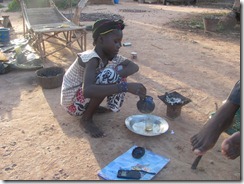
It would be pretty tough for someone who hasn’t been here to understand the importance of tea in the culture of Mali. Drinking tea is the national past time here, and people take it pretty seriously. Tea brewing ability is a skill that is prized and I am not the only volunteer that has attempted to improve there tea prowess. You might be thinking, “But Jim all you do to make tea is heat up water and put in the tea bag.” However, tea is way more than that here. First, heating up water is not nearly as simple as you would thinking. You have to light some coals and get them rolling. One technique, especially popular with the kids, is to grab the grill/coal holder thing and swing it around very fast with your arm fully extended. If you can’t picture that, YouTube Pete Townsend’s famous windmill strum on the guitar, remove the guitar/pick and replace them with a bucket filled with hot coals and you’ll get the idea. Second, all of the tea is loose leave (if it comes in a tea bag and you say “this is tea” they will look at you weird and tell you it is “Lipton”, not tea). Said tea is shoved into a small tea pot then placed along with the water onto the coals. Next you wait, from what I’ve noticed you pretty much just wing the length of time. Once the tea has brewed long enough you pour it into a second tea pot and add a shot glass or so of sugar to the tea (Malians love sugar). The second tea pot goes on the coals to heat for a while. Then the true skill is displayed. To dissolve the sugar the tea make pours the tea into a shot glass, the further apart the tea pot and the shot glass are from each other the better. You repeat this action a lot and serve the tea in a shot glass. That is the first round. You repeat all of these steps three times. I’m pretty sure the entire population of Mali is addicted to tea.

I'd have pictures, but the internet cafe lady is streaming some tunes and hogging all the bandwidth.